
How Much Should I Feed My Dog? — The Australian Owner's Guide
The feeding guide on the bag is a starting point, not a rule. Here's how to work out the right amount for your specific dog.
Use body condition scoring (feel ribs easily, see visible waist) as your guide — not just weight or the bag's feeding chart
Desexed dogs need 20–30% fewer calories; most Australian dog owners don't adjust after desexing — this is the #1 cause of pet obesity
Treats should be no more than 10% of daily calories — a few dog biscuits can account for 20% of a small dog's daily intake
Affiliate Disclosure: As an Amazon Associate I earn from qualifying purchases. Product links on this page go to Amazon AU. Prices shown are approximate — check Amazon for current pricing.
- 🐾Bag feeding guides are rough estimates only
- ✂️Desexing = 20–30% fewer calories needed
- 🍪Treats max 10% of daily calorie intake
- 📊Body condition score beats weight every time
- 🇦🇺56% of AU dogs are overweight
The feeding guide on your dog food bag is written for a hypothetical "average" dog. It doesn't know your dog is desexed, mostly sedentary, or 9 years old. That's why following it blindly is the single biggest reason Australian dogs end up overweight.
of Australian dogs are overweight — most because owners follow bag guides and don't adjust
fewer calories desexed dogs need compared to intact dogs of the same size and activity level
of daily calories is the maximum treats should represent — often exceeded dramatically
Body Condition Score — Your Real Feeding Guide
Weight alone is misleading — use body condition scoring
A 25 kg Labrador with excess fat and a 25 kg muscular Labrador both weigh the same. Body condition score (BCS) measures the actual fat coverage, not just mass. This is what vets use, and you can do it at home in 30 seconds.
| BCS | Condition | Ribs | Waist from above | What to do |
|---|---|---|---|---|
| 1–2 | Underweight | Visible with no pressure | Severe hourglass | Increase food by 20%, vet check |
| 3–5 | ✅ Ideal | Easily felt, not visible | Clear waist visible | Maintain current portions |
| 6–7 | Overweight | Need firm pressure to feel | No visible waist | Cut portions 10–15% |
| 8–9 | Obese | Cannot feel through fat | Rounded, no waist | Vet review + calorie restriction |
Run your hand along your dog's ribcage with gentle pressure. You should feel individual ribs easily — like knuckles under a thin sheet. Now look down from above: a visible waist between ribs and hips = healthy. No waist = overweight. That simple test beats every bag guide.
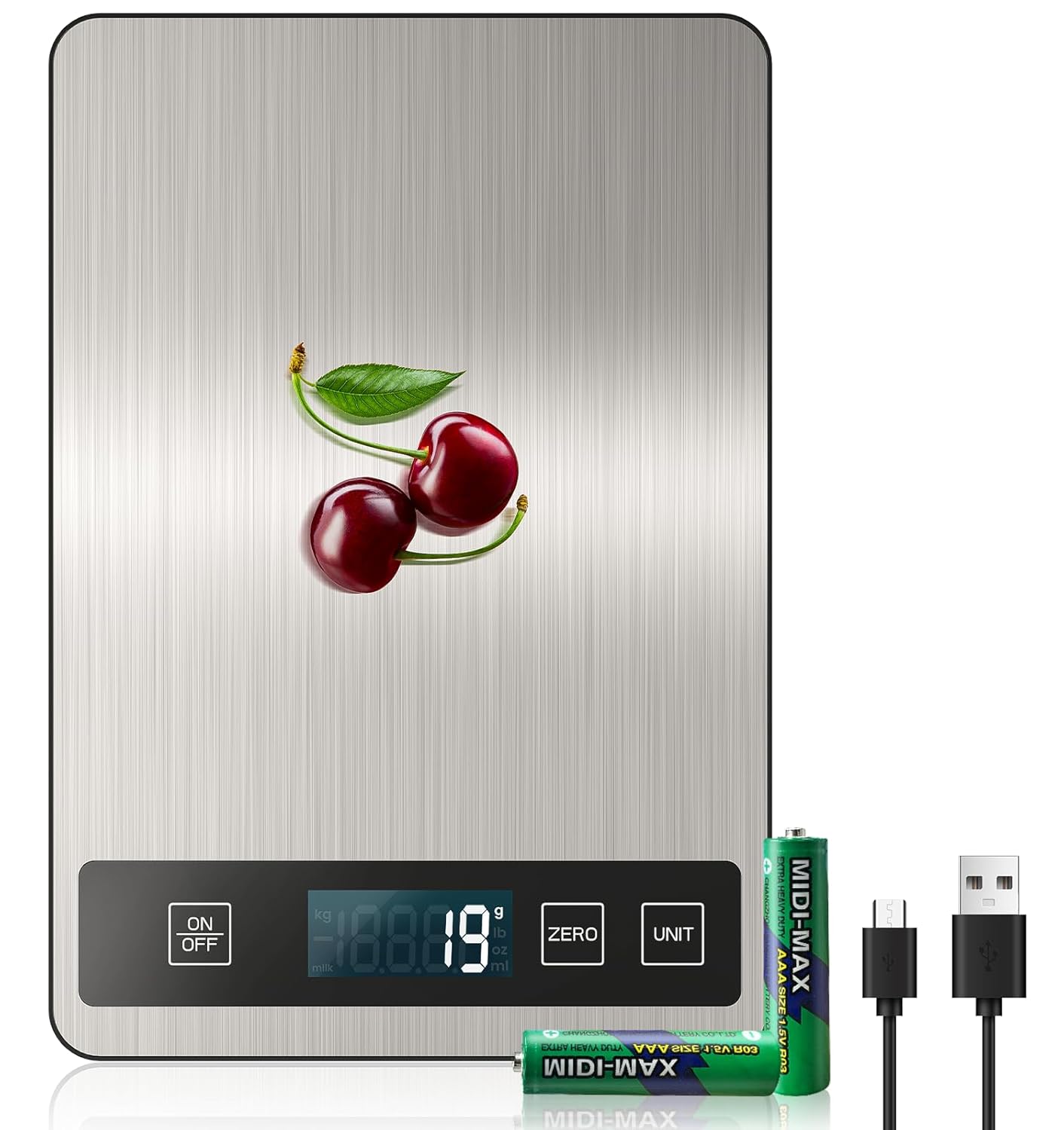
Digital Kitchen Scale for Dog Portions
Precision gram-level scale for measuring kibble consistently. The single most effective tool for portion control — most owners are shocked how much they've been overpouring when they finally measure.
Calculating the Right Daily Calories
Formula: Resting Energy Requirement (RER) = 70 × (body weight in kg)^0.75. Then multiply by your dog's activity level to get their actual daily need.
| Dog type | Multiplier | 25 kg example | 10 kg example |
|---|---|---|---|
| Desexed, sedentary (indoors mostly) | 1.2–1.4 | ~1,080–1,260 cal/day | ~500–580 cal/day |
| Intact, moderate activity (daily walks) | 1.5–1.8 | ~1,350–1,620 cal/day | ~620–750 cal/day |
| Active (daily runs, agility) | 2.0–2.5 | ~1,800–2,250 cal/day | ~830–1,040 cal/day |
| Growing puppy | 2.5–3.0 | N/A — use puppy food guide | N/A — use puppy food guide |
Most Australian backyard dogs need less than the bag says
The Labrador in a suburban backyard getting a 30-minute walk daily is sedentary by calorie standards. Use the 1.2–1.4 multiplier. That same bag guide was written for an "average" dog that may be more active than yours.
Feeding by Life Stage
| Life stage | Meals per day | Calorie adjustment vs adult | Key consideration |
|---|---|---|---|
| Puppy (8 wks – 4 months) | 3–4 meals | +100 to 200% more | Small stomach — spread across meals |
| Puppy (4–12 months) | 2–3 meals | +50 to 100% more | Large breeds: don't overfeed for growth rate |
| Adult intact (1–7 yrs) | 2 meals | Baseline | Use RER × activity multiplier |
| Desexed adult | 2 meals | −20 to 30% | Most owners miss this adjustment |
| Senior (7+ yrs) | 2–3 meals | −10 to 15% | Lower quantity, higher quality protein |
| Pregnant or nursing | 3+ meals | +50 to 100% | Vet guidance essential |
The Treat Trap — Where Portions Fall Apart

Slow-Feeder Bowl
Built-in ridges force slower eating, which increases satiety signals before the meal is finished. Dogs feel fuller eating the same amount. Helps with portion control by making meals more satisfying.
When to Adjust Portions

Treat Dispensing Puzzle Bowl
Interactive puzzle that makes dogs work for their food. Slows eating, provides mental stimulation, and makes meals more satisfying without increasing quantity. Ideal for overweight dogs and fast eaters.