
Best Puppy Food in Australia 2025 — What to Feed in the First Year
The first 12 months are the most nutritionally critical of your dog's life. Here's what Australian vets actually recommend.
Large breed puppies MUST eat large-breed puppy food — excess calcium in standard food causes joint disease that shows up at age 4–5
Feed 3–4 times daily until 4 months, then 2 times daily from 6 months onwards — switch to adult food at 12 months
Stick to vet-recommended brands: Royal Canin, Hill's Science Diet, Advance, or Black Hawk — avoid grain-free and supermarket brands
Affiliate Disclosure: As an Amazon Associate I earn from qualifying purchases. Product links on this page go to Amazon AU. Prices shown are approximate — check Amazon for current pricing.
- 🦴Large breed formula: non-negotiable
- 🍽️4 meals/day until 4 months, then 2
- 📅Switch to adult food at 12 months
- ⚠️Grain-free linked to heart disease in puppies
- 🐾Transition over 10 days to avoid upset
What you feed your puppy in the first 12 months shapes their bones, joints, immune system, and metabolism for the rest of their life. The wrong food — especially for large breeds — can cause skeletal disease that doesn't show until age 4 or 5 and can never be fully reversed.
how long to feed puppy formula before switching to adult food
adult weight threshold — above this, large-breed puppy food is mandatory
minimum transition period when switching foods to avoid digestive upset
The Single Most Important Decision: Large vs Small Breed Food
Large breed puppies need lower calcium — not more
Large breed puppies (adult weight over 25 kg) grow rapidly. Too much calcium causes uncontrolled, irregular bone development — leading to hip dysplasia, elbow dysplasia, and osteochondrosis. Large-breed puppy food has specifically lower calcium and phosphorus ratios designed for safe growth. Feeding standard adult or small-breed puppy food to a large breed puppy is one of the most common preventable causes of joint disease in Australia.
| Breed size | Adult weight | Food required | Switch to adult at |
|---|---|---|---|
| Small breed (Chihuahua, Maltese, Toy Poodle) | Under 10 kg | Small breed or all-life-stages puppy food | 10 months |
| Medium breed (Cavoodle, Beagle, Staffordshire Bull Terrier) | 10–25 kg | Standard puppy formula | 12 months |
| Large breed (Labrador, Golden Retriever, German Shepherd) | 25–45 kg | ⚠️ LARGE BREED puppy food | 12 months |
| Giant breed (Great Dane, Mastiff, St. Bernard) | Over 45 kg | ⚠️ LARGE BREED puppy food | 18–24 months |
Feeding Schedule: When and How Much
| Age | Meals per day | Which food | Key note |
|---|---|---|---|
| 8 weeks – 4 months | 3–4 meals | Puppy formula (breed-specific) | Small stomachs need frequent feeding |
| 4 months – 6 months | 3 meals | Puppy formula (breed-specific) | Reducing frequency as stomach grows |
| 6 months – 12 months | 2 meals | Puppy formula (breed-specific) | Morning and evening, equal portions |
| 12 months + | 2 meals | Adult formula (size-specific) | Transition gradually over 10 days |
How to check if you're feeding the right amount
You should feel your puppy's ribs easily with gentle pressure — not visible from above, but not buried under fat. A visible waist when viewed from above is the key sign of healthy weight. If you can't feel ribs at all, reduce by 10% and recheck in 2 weeks.
What to Look for on the Label
Top Picks for Large Breed Puppies

Royal Canin Large Breed Puppy
The gold standard for large breed puppies. Every Australian vet clinic stocks this — balanced calcium and phosphorus to support slow, safe bone growth. Highly digestible protein for gut health during the critical growth phase.
Hill's Science Diet Large Breed Puppy
Research-backed formula from a major veterinary nutrition company. Excellent joint protection, probiotics for gut health, and easy on sensitive puppy stomachs. Great alternative to Royal Canin at a similar price point.
Top Picks for Small & Medium Breed Puppies

Advance Puppy All Breeds
Affordable, Australian-made puppy food for small and medium breeds. Made by Nestlé Purina to vet-approved standards. Good balance of protein, digestibility, and price — the best budget option for non-large breeds.
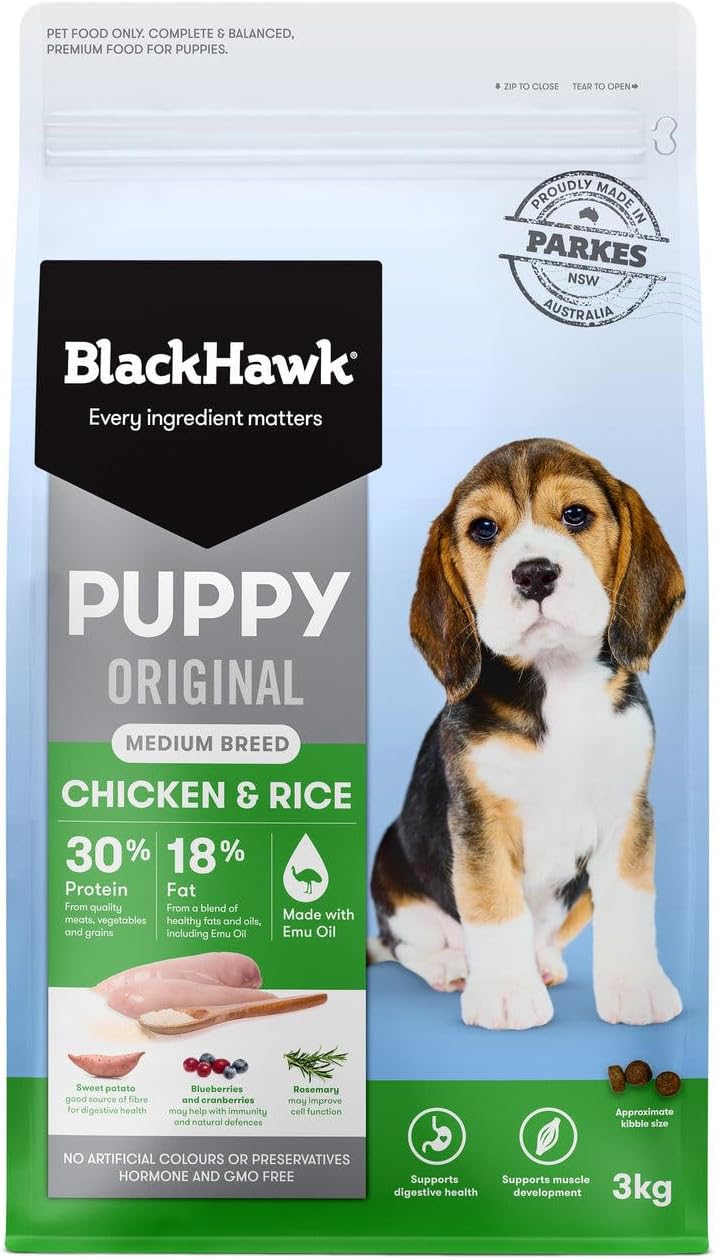
Black Hawk Puppy
Premium Australian brand with high-quality, grain-inclusive ingredients. Higher meat content than budget brands, popular with Australian breeders. Excellent choice for small and medium breeds wanting a step up from standard options.
Transitioning Food: How to Do It Without Digestive Upset
Always transition gradually — abrupt changes cause diarrhoea
Days 1–3: 25% new food, 75% old food
Mix a small amount of new food into the existing food. Keep the ratio heavily weighted toward the food your puppy already knows. Watch for any loose stools or vomiting.
Days 4–6: 50% new food, 50% old food
Equal mix. Most puppies handle this well if the first phase went smoothly. Continue monitoring stool consistency — firm and brown is ideal.
Days 7–10: 75% new food, then 100%
Increase to 75% new food for days 7–8, then switch fully. By day 10 your puppy should be fully transitioned without digestive issues.